
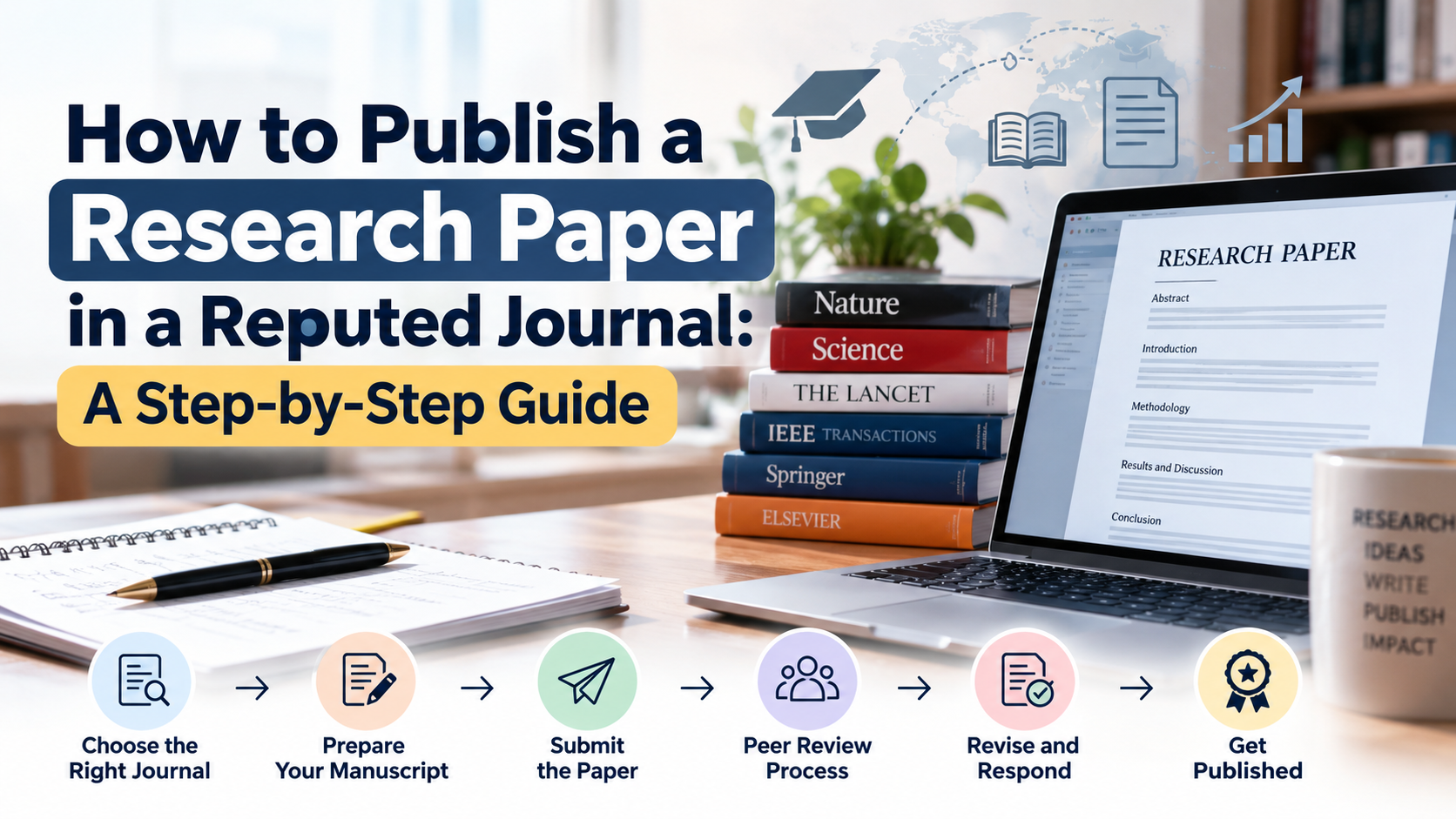
Publishing a research paper in a reputed academic journal is an important milestone for researchers, PhD scholars, professors, research fellows, and academic professionals. A credible publication can help researchers share their findings with the academic community, strengthen their research profile, support academic collaborations, and contribute to knowledge in their field.
However, the process of publishing a research paper involves more than writing a manuscript and submitting it to a journal. Researchers must identify a suitable journal, prepare an original manuscript, follow publication guidelines, maintain research ethics, respond to peer-review comments, and complete the required revisions.
Many researchers search for how to publish a research paper in a reputed journal, how to find a Scopus-indexed journal, or how to get research paper publication support for PhD scholars. Understanding the complete publication process can help them make informed decisions and avoid common mistakes.
In this guide, we explain how to publish a research paper step by step, how to choose the right academic journal, how to prepare a manuscript for submission, and how professional journal publication support can help researchers navigate the process.
What Is a Reputed Research Journal?
A reputed research journal is a scholarly publication recognised for its editorial standards, transparent peer-review process, research integrity, and contribution to its academic discipline.
Such journals evaluate manuscripts based on factors including originality, methodological quality, relevance, evidence, clarity, and suitability for their readership.
Depending on the discipline and publication requirements, researchers may consider journals indexed in databases such as Scopus, Web of Science, and PubMed, or journals recognised by relevant academic and regulatory bodies.
However, journal reputation and indexing are not the same thing. Indexing status alone does not guarantee that a journal is suitable for every researcher or that a manuscript will be accepted.
Before submitting a paper, researchers should verify the journal's current indexing status, publisher information, editorial board, peer-review policy, publication ethics, and scope.
Why Is Publishing a Research Paper Important?
Research publication plays an important role in academic development and the dissemination of new knowledge.
1. Strengthens Academic Credentials
Publishing original research can strengthen an academic profile by demonstrating subject knowledge, research skills, and the ability to communicate findings in a scholarly format.
For PhD scholars and early-career researchers, relevant publications may also support applications for academic positions, research fellowships, and postdoctoral opportunities, depending on the institution's eligibility criteria.
2. Increases Research Visibility
A published research paper makes findings accessible to other scholars, educators, practitioners, and researchers working in related areas.
When published through credible channels, research can become part of the wider academic discussion and may be cited by subsequent studies.
3. Supports Career and Research Opportunities
Some academic institutions and research positions consider publications when evaluating candidates. The specific requirements vary by institution, discipline, and role.
Researchers should therefore understand the applicable publication criteria before selecting a journal.
4. Encourages Academic Collaboration
Publishing research can help authors connect with other researchers who share similar interests, identify opportunities for collaborative projects, and develop new research questions.
5. Contributes to Knowledge Development
Research publications allow scholars to present evidence, test hypotheses, evaluate existing theories, and communicate new insights that can inform future studies.
How to Publish a Research Paper in a Reputed Journal: Step-by-Step Process
The following steps explain how researchers can prepare, submit, and manage a manuscript through the academic journal publication process.
Step 1: Choose a Relevant Research Topic
The first step is to identify a research topic that addresses a meaningful question in your field.
A strong topic should be relevant to the discipline, supported by an appropriate research methodology, and capable of contributing something useful to existing knowledge.
Before finalising your topic, consider the following questions:
- Does the topic address a clear research problem?
- Is there sufficient existing literature to establish the research gap?
- Can the research question be investigated with available data and methods?
- Is the subject relevant to current academic discussions?
- Can the findings contribute to theory, practice, or future research?
For example, a researcher in computer science might investigate a new approach to cybersecurity, while a management researcher could examine the relationship between digital transformation and organisational performance.
A clearly defined research topic provides a stronger foundation for manuscript preparation and journal selection.
Step 2: Conduct a Comprehensive Literature Review
A literature review helps researchers understand what is already known about their topic and identify areas that require further investigation.
Search relevant academic databases, journal websites, conference proceedings, and other credible scholarly sources.
Depending on your discipline, useful resources may include Google Scholar, Scopus, Web of Science, PubMed, and subject-specific research databases.
During the literature review, identify:
- Major theories and concepts related to the topic
- Important previous studies and their findings
- Research methods used by other scholars
- Contradictions or limitations in existing evidence
- Gaps that your research could address
Organise your references carefully and record complete bibliographic information. Reference-management tools can help researchers maintain consistent citations and reduce formatting errors.
A well-developed literature review demonstrates familiarity with the field and helps establish why the proposed research matters.
Step 3: Design and Conduct Original Research
Original research should follow a clear and appropriate methodology.
The methodology depends on the research question and may involve experiments, surveys, interviews, case studies, statistical analysis, systematic reviews, computational models, or other recognised approaches.
A strong research methodology should explain:
- The research design and objectives
- The population, sample, or data sources, where applicable
- The data collection procedures
- The analytical methods used
- The limitations of the study
- Relevant ethical approvals and consent procedures
Researchers should maintain accurate records of their data and analytical decisions. Findings must be reported honestly, including limitations or results that do not support the original hypothesis.
If the study involves human participants, animals, confidential information, or other regulated research activities, ensure that applicable approvals and ethical requirements are satisfied.
Step 4: Write a High-Quality Research Manuscript
Once the research is complete, prepare the manuscript according to the conventions of your discipline and the requirements of your target journal.
A typical empirical research paper contains the following sections.
- Title: A concise, informative title that communicates the main subject of the research.
- Abstract: A summary of the research problem, objectives, methods, principal findings, and conclusions.
- Keywords: Relevant terms that help readers and indexing systems understand the paper's subject.
- Introduction: Background information, the research problem, the existing knowledge gap, and the objectives of the study.
- Literature Review: A critical discussion of relevant previous research and the theoretical foundation, where appropriate.
- Methodology: A clear explanation of the research design, data sources, procedures, and analytical techniques.
- Results: The findings presented accurately through text, tables, figures, or statistical outputs as appropriate.
- Discussion: An interpretation of the findings in relation to the research questions and previous studies.
- Conclusion: The main contribution, implications, limitations, and possible directions for future research.
- References: A complete list of cited sources formatted according to the journal's requirements.
Not every journal uses this exact structure. Review articles, theoretical papers, case reports, and other manuscript types may require different sections.
Researchers seeking research paper writing, editing, and proofreading services should prioritise services that improve clarity, structure, grammar, and presentation while preserving the author's original ideas and responsibility for the research.
Step 5: Select the Right Journal for Your Research
Choosing the right journal is one of the most important steps in the publication process.
Even a well-prepared manuscript may be rejected if it does not match the journal's subject area, audience, article types, or editorial priorities.
Start by reviewing journals that have published research on similar topics. Examine their aims and scope, recently published articles, author guidelines, and submission requirements.
Consider the following factors when evaluating a journal:
- Scope and subject relevance: Confirm that the journal publishes work in your research area.
- Indexing status: If indexing is important for your academic requirements, verify it through the relevant database's official records.
- Peer-review process: Check whether the journal describes a credible and transparent review procedure.
- Editorial board: Review the listed editors and their academic affiliations.
- Publication ethics: Look for clear policies on plagiarism, conflicts of interest, corrections, retractions, and research integrity.
- Publication charges: Check whether submission fees, article processing charges, or other costs apply.
- Publication timelines: Review any published information about review and production timelines, while recognising that actual processing times vary.
- Open-access policy: Determine whether the article will be open access or available through a subscription model, and understand any associated terms.
Researchers looking for Scopus indexed journal publication support should remember that Scopus indexing must be verified for the specific journal title and current coverage period. A journal's claim of indexing is not sufficient evidence by itself.
Likewise, researchers who need a journal for a particular institutional requirement should verify the applicable rules directly with their university or relevant authority.
Step 6: Check the Journal's Author Guidelines
Before submitting a manuscript, read the journal's instructions for authors carefully.
These guidelines explain how the manuscript should be formatted and what documents must accompany the submission.
Common requirements include:
- Word count and article structure
- Font, spacing, and page layout
- Reference and citation style
- Abstract length and keyword limits
- Figure and table specifications
- Author information and affiliations
- Conflict-of-interest declarations
- Funding statements
- Ethics approval and consent information
- Data availability statements
- Supplementary files and cover letters
Some journals require a blinded manuscript without identifying author information, while others request a separate title page.
Following the guidelines helps reduce avoidable administrative delays and demonstrates attention to publication requirements.
Step 7: Check Originality and Research Ethics
Academic integrity is essential throughout the publication process.
Before submitting your manuscript, review the paper for proper citation, accurate reporting, appropriate use of sources, and compliance with the journal's ethical policies.
An originality or similarity report may help identify passages that need closer examination. However, a similarity percentage alone does not establish whether a manuscript is plagiarised. Properly cited quotations, references, standard terminology, and overlapping methodological language can affect the result.
Researchers should address inappropriate overlap, cite sources correctly, and ensure that all borrowed ideas and materials are properly acknowledged.
Other important ethical considerations include:
- Avoiding fabricated or manipulated data
- Not submitting the same manuscript to multiple journals simultaneously unless explicitly permitted by the relevant policies
- Obtaining consent and approvals where required
- Disclosing funding and relevant conflicts of interest
- Confirming that all listed authors meet appropriate authorship criteria
- Securing permission to reuse copyrighted figures or material where necessary
If AI tools are used during manuscript preparation, follow the target journal's disclosure and usage policies. Authors remain responsible for factual accuracy, originality, citations, and the integrity of the submitted work.
Step 8: Prepare a Professional Cover Letter
Many journals request a cover letter explaining why the manuscript is suitable for consideration.
A good cover letter should be concise and specific to the journal.
It commonly includes:
- The manuscript title
- The article type
- The main research question or contribution
- Why the paper fits the journal's scope
- Confirmation that the submission complies with relevant journal policies
- Any required declarations about prior publication or simultaneous submission
Avoid exaggerated claims about the importance or impact of the research. Instead, explain the contribution clearly and accurately.
A tailored cover letter can help editors understand the manuscript's relevance, although it does not guarantee acceptance.
Step 9: Submit the Research Paper Online
Most academic journals use online manuscript submission systems.
The process typically involves creating an author account, entering manuscript details, uploading files, providing author information, selecting relevant classifications, and completing required declarations.
Before submitting, verify that:
- The manuscript file is complete.
- The title and abstract match the final version.
- All authors and affiliations are correctly entered.
- Figures, tables, and supplementary files are included.
- References and citations are consistent.
- Required ethical statements and disclosures are present.
- The manuscript meets the journal's formatting requirements.
After submission, save the confirmation email and manuscript identification number.
Researchers who require journal publication assistance for PhD scholars may benefit from administrative and editorial guidance during manuscript preparation and submission. However, the author should retain control over the research, approve the final manuscript, and ensure that every submission is accurate.
Step 10: Understand the Peer-Review Process
After submission, the journal generally performs an initial editorial assessment.
The editor may evaluate the manuscript's scope, originality, methodological suitability, completeness, and relevance before deciding whether to send it for peer review.
Possible outcomes include:
- Desk rejection: The editor declines the manuscript without external peer review, often because of scope mismatch, insufficient contribution, or other editorial concerns.
- Under review: The manuscript is being evaluated by reviewers or is progressing through the journal's review process.
- Minor revision: The editor requests relatively limited changes before making a further decision.
- Major revision: Substantial revisions, additional explanations, analyses, or clarifications are requested.
- Rejection after review: The manuscript is not accepted following editorial and reviewer assessment.
- Acceptance: The journal agrees to publish the manuscript, subject to any remaining production requirements.
The process varies by journal and article type. Researchers should not assume that every submission will receive external peer review or that acceptance is guaranteed.
Step 11: Respond to Reviewer Comments Carefully
Reviewer feedback is a normal part of academic publishing. Even strong manuscripts may require clarification, additional analysis, or substantial revisions.
When revisions are requested, read each comment carefully and prepare a structured response document.
A useful response-to-reviewers document includes:
- The reviewer's original comment.
- Your response to the comment.
- A clear description of the change made.
- The location of the revision in the manuscript, where appropriate.
Address every comment professionally. If you disagree with a suggestion, explain your reasoning respectfully and support it with relevant evidence or methodological considerations.
Do not claim to have made a change that is absent from the revised manuscript.
Before resubmission, review the revised paper for consistency, update relevant tables and references, and ensure that the response document matches the final version.
Step 12: Complete Acceptance and Publication Formalities
Once the manuscript is accepted, the journal may request final files, copyright or licence agreements, publication declarations, and other production materials.
The paper may then undergo copyediting, typesetting, author proofing, and online publication.
Carefully review the proof to identify typographical errors, formatting problems, incorrect author details, or other production issues.
Do not introduce substantial unapproved changes during proof correction.
After publication, save the final article, DOI where assigned, citation details, and any permitted repository version. Share the research in accordance with the journal's copyright and self-archiving policies.
How to Find a Scopus-Indexed or Web of Science Journal
Researchers frequently search for Scopus journal publication services, Web of Science journal publication support, and reputable indexed journals to meet specific academic or research objectives.
The correct journal depends on your subject, manuscript quality, institutional requirements, and publication goals.
Follow these steps to evaluate a potential journal:
- Search for journals publishing work in your subject area.
- Visit the official Scopus Sources or Web of Science journal-listing resources, as applicable.
- Verify the exact journal title and ISSN.
- Check the current coverage status and any relevant coverage dates.
- Review the publisher's official website and publication ethics policies.
- Confirm the journal's aims, scope, review process, and publication fees.
- Verify whether your institution accepts that journal for the purpose you have in mind.
Be cautious of websites that promise guaranteed publication, guaranteed indexing, or acceptance within an unrealistically short period.
A legitimate publication outcome depends on editorial decisions, research quality, journal policies, and the peer-review process. No ethical publication consultant can guarantee that an independent journal will accept a manuscript.
Common Reasons Why Research Papers Get Rejected
Understanding common rejection reasons can help researchers improve their manuscripts before submission.
1. Poor Journal Selection
A paper may be scientifically sound but unsuitable for the journal's subject area or audience.
How to improve: Review the journal's scope and recently published articles before submitting.
2. Limited Originality
A manuscript may not explain how it advances existing knowledge or differs from earlier studies.
How to improve: Establish a clear research gap and describe the specific contribution of your work.
3. Weak Research Methodology
Insufficient methodological detail, inappropriate analysis, or unsupported conclusions can undermine a paper.
How to improve: Explain the research design clearly, justify the methods, and acknowledge limitations.
4. Poor Academic Writing
Unclear arguments, inconsistent terminology, grammatical errors, and weak organisation can make research difficult to evaluate.
How to improve: Revise the structure, improve clarity, and consider independent academic proofreading.
5. Incomplete Formatting or Documentation
Missing declarations, incorrectly formatted references, incomplete figures, or absent supplementary files can delay editorial processing.
How to improve: Use the journal's submission checklist before uploading the manuscript.
6. Research Ethics Concerns
Plagiarism, inaccurate data reporting, undisclosed conflicts of interest, or inappropriate authorship can result in rejection and potentially more serious consequences.
How to improve: Follow recognised research-integrity standards and review all declarations before submission.
7. Inadequate Response to Reviewers
Ignoring comments or responding defensively without evidence can weaken a revised submission.
How to improve: Prepare a point-by-point response and explain any justified disagreements professionally.
How Professional Research Paper Publication Support Can Help
The research publication process can be challenging, particularly for first-time authors, PhD scholars, early-career academics, and researchers working under institutional deadlines.
Professional publication support may help authors improve the presentation of their work and navigate journal requirements more efficiently.
Depending on the provider, support may include:
- Journal selection guidance: Identifying potential journals based on the manuscript's subject, scope, and publication requirements.
- Manuscript editing and proofreading: Improving grammar, readability, academic tone, and consistency without changing the research findings.
- Research paper formatting: Aligning the manuscript with journal-specific instructions for authors.
- Reference and citation checks: Reviewing citation consistency and bibliographic formatting.
- Submission assistance: Helping authors understand the submission system and required documentation.
- Peer-review response support: Assisting authors in organising reviewer comments and preparing clear responses while preserving the author's independent academic judgement.
- Publication process guidance: Explaining editorial decisions, revision stages, proof corrections, and publication formalities.
When choosing research paper publication services in India, evaluate the provider's transparency, subject expertise, ethical standards, and clearly defined scope of work.
Avoid services that offer fabricated results, guaranteed acceptance, fake indexing claims, or undisclosed authorship arrangements.
Professional assistance should support the quality and presentation of genuine research, not replace the researcher's responsibility or compromise academic integrity.
Research Paper Publication Support at ResolGlobal
Researchers seeking guidance with the academic publication process can explore the services offered by ResolGlobal.
ResolGlobal provides journal publication guidance and manuscript proofreading and editing services to support researchers through different stages of preparing and submitting academic work.
Depending on your requirements, you can explore its journal publication services to learn more about the available support and determine whether it is appropriate for your manuscript.
Before engaging any publication support provider, clarify the scope of assistance, fees, expected deliverables, confidentiality arrangements, and the responsibilities that remain with the author.
Researchers should independently verify the target journal's credentials and retain responsibility for the accuracy, originality, ethical compliance, and final approval of their work.
The goal is to prepare a strong, appropriately targeted manuscript and navigate the publication process with greater clarity—not to promise a particular editorial outcome.
Frequently Asked Questions About Research Paper Publication
- How can I publish a research paper in a reputed journal?
Choose a relevant research topic, conduct original research, prepare a high-quality manuscript, select a suitable journal, follow its author guidelines, and submit the paper for editorial assessment and peer review. Address reviewer comments carefully and complete the required publication formalities if accepted. - How do I choose the best journal for my research paper?
Consider the journal's scope, audience, editorial standards, peer-review process, publication ethics, indexing status where relevant, fees, and publication requirements. Review recently published papers and verify important claims through official sources. - Can PhD scholars get help with research paper publication?
Yes. PhD scholars may seek ethical assistance with journal selection, editing, proofreading, manuscript formatting, submission requirements, and responses to reviewer comments. Researchers must remain responsible for their research and final submissions. - How can I publish a research paper in a Scopus-indexed journal?
Identify journals relevant to your research, verify their current Scopus coverage through official sources, and review their submission and publication requirements. Submit an original, well-prepared manuscript and follow the journal's editorial process. Scopus indexing does not guarantee acceptance. - How long does it take to publish a research paper?
Publication timelines vary widely by journal, discipline, review complexity, revision requirements, and production schedules. Check the journal's published information and understand that actual timelines may differ. - Is professional research paper editing necessary?
Professional editing is not mandatory for every manuscript, but it can help improve clarity, grammar, organisation, and compliance with journal requirements. Editing cannot compensate for weak research design or guarantee acceptance. - What is the difference between journal acceptance and publication?
Acceptance means the journal has agreed to publish the manuscript, subject to any remaining requirements. Publication generally occurs after production steps such as copyediting, typesetting, proof correction, and online or print release. - How can I avoid predatory journals?
Verify the publisher, editorial board, peer-review process, indexing claims, publication ethics, and fee transparency. Be cautious of unsolicited invitations, false impact-factor claims, guaranteed acceptance, and misleading journal websites. - Can a rejected research paper be submitted to another journal?
In many cases, yes. Review the rejection decision, improve the manuscript where appropriate, and identify a better-fitting journal. Before submitting elsewhere, confirm that the previous submission has been closed and that no conflicting submission or publication restrictions apply. - Where can I get research paper publication support in India?
You can explore academic publication consultants and editing providers that offer transparent, ethical services. Review their expertise, fees, confidentiality policies, and scope of work before proceeding. ResolGlobal provides journal publication guidance and proofreading and editing services that researchers can explore through its official website.
Conclusion
Publishing a research paper in a reputed journal requires careful planning, original research, appropriate journal selection, clear academic writing, and adherence to publication ethics.
From identifying a research gap and preparing a manuscript to submitting it for peer review and responding to revisions, each stage contributes to the quality and credibility of the final publication.
Researchers should prioritise journal suitability and genuine scholarly contribution over promises of fast or guaranteed publication. They should also verify indexing claims independently and follow their institution's specific publication requirements.
For researchers who need help navigating manuscript preparation and journal submission, professional research publication support can provide useful editorial and procedural guidance.
Explore ResolGlobal's journal publication services to learn about available support for your academic publication journey and take an informed next step towards submitting your research to a suitable journal.