
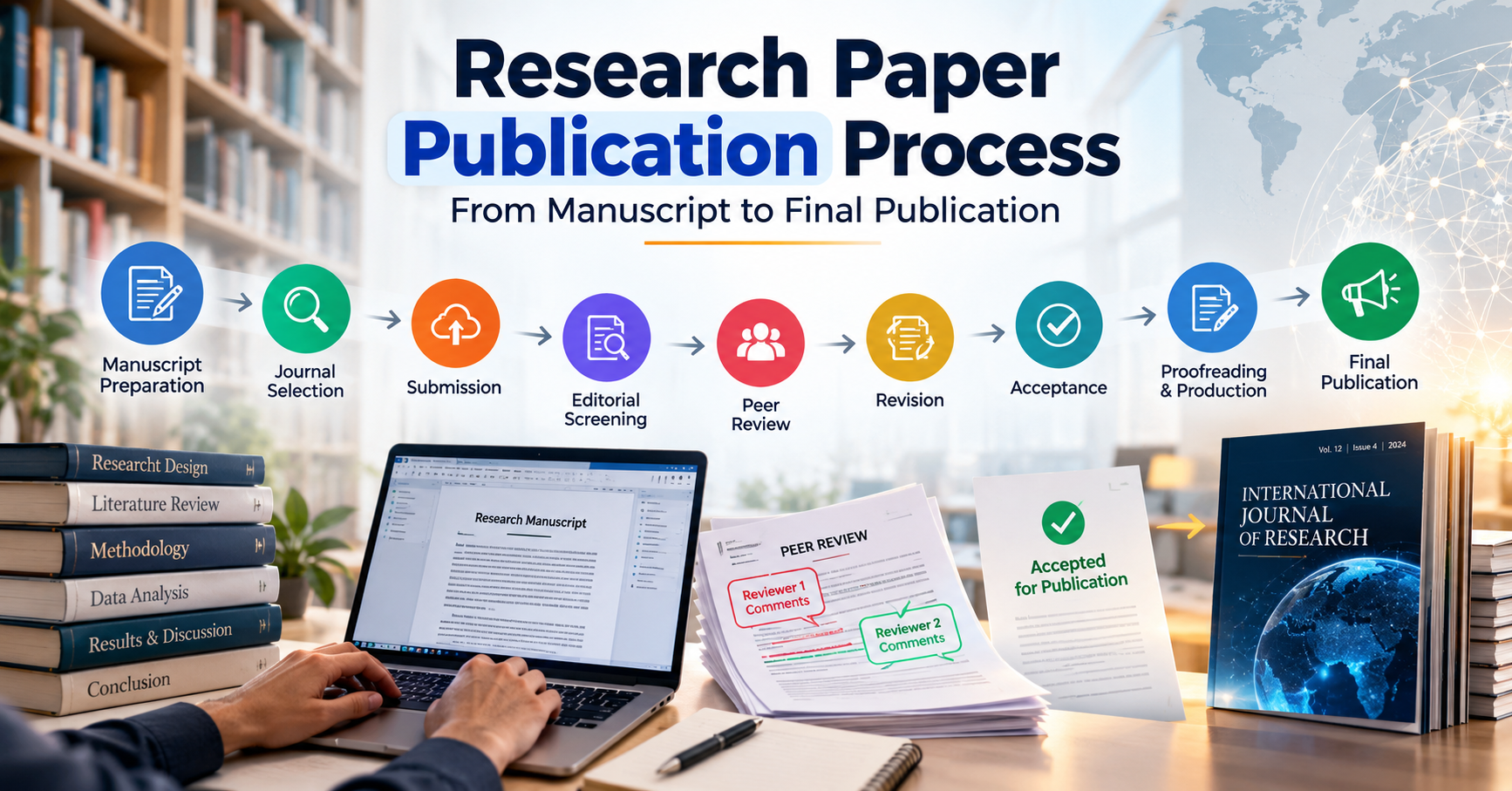
Research Paper Publication Process: From Manuscript to Final Publication
Publishing a research paper in a reputed academic journal is an important milestone for researchers, PhD scholars, university students, and academicians. However, the research paper publication process involves much more than writing a manuscript and submitting it to a journal. Researchers must select an appropriate journal, follow its author guidelines, complete the submission requirements, respond to peer-review comments, and prepare the final manuscript for publication.
Understanding the research paper publication process step by step can help researchers avoid common mistakes, improve manuscript quality, and make informed decisions when choosing a journal. Whether you are preparing your first academic paper or looking to publish in a reputed, peer-reviewed journal, knowing what happens at each stage can make the process more manageable.
In this guide, we explain the complete research paper publication process, from manuscript preparation to final publication, along with practical tips to improve your chances of successful journal submission.
What Is the Research Paper Publication Process?
The research paper publication process is the series of academic and editorial steps through which original research is evaluated, reviewed, revised, and published in a scholarly journal.
The process generally includes manuscript preparation, journal selection, submission, editorial screening, peer review, manuscript revision, final acceptance, proofreading, and publication.
The exact procedure varies depending on the journal, research discipline, publisher, and article type. Some journals may request additional technical checks, ethical declarations, or revisions before accepting a paper.
Step 1: Prepare a High-Quality Research Manuscript
The first step in the academic paper publication process is preparing a well-structured, original, and scientifically sound manuscript.
Before submitting your research paper to a journal, ensure that it presents a clear research problem, a relevant literature review, a suitable methodology, reliable findings, and meaningful conclusions.
A typical research paper contains the following sections:
-
Title: Clearly communicates the subject and scope of the research.
-
Abstract: Summarises the research objective, methodology, principal findings, and conclusions.
-
Keywords: Helps readers and academic databases identify the paper's subject.
-
Introduction: Explains the research problem, background, objectives, and research gap.
-
Literature Review: Evaluates relevant previous studies and establishes the context for the research.
-
Methodology: Describes the research design, data collection, and analytical methods.
-
Results: Presents the findings clearly and accurately.
-
Discussion: Explains the significance of the findings and compares them with previous research.
-
Conclusion: Summarises the main contribution, limitations, and possible future research directions.
-
References: Lists the sources cited in the manuscript using the required referencing style.
Not every article follows this structure. Review papers, theoretical articles, case studies, and discipline-specific manuscripts may require different sections.
Before proceeding with research paper submission to a journal, check grammar, academic language, citation accuracy, figure quality, table formatting, and consistency throughout the manuscript.
Step 2: Select the Right Academic Journal
Choosing the right journal is one of the most important decisions in the research paper publication process. A well-written manuscript can still be rejected if it does not match the journal's scope or publication requirements.
Researchers looking for a reputed journal for research paper publication should evaluate the following factors.
Journal Scope and Research Relevance
Read the journal's aims and scope to determine whether it publishes research related to your subject. Review recent articles to understand the topics, methodologies, and types of contributions the journal accepts.
Indexing and Reputation
Verify a journal's current indexing status through the relevant official database, such as Scopus or Web of Science, where applicable. Check the journal's official website and the database's source records rather than relying only on promotional claims.
Peer-Review Policy
Understand whether the journal uses single-anonymous, double-anonymous, open, or another peer-review model. A transparent journal should explain its editorial and review procedures.
Publication Fees
Check whether the journal charges submission fees, article processing charges (APCs), or other publication-related fees. Open-access publication may involve charges, although not every open-access journal requires authors to pay.
Publication Timeline
Review the journal's published information about editorial decisions and publication timelines. Actual processing time can vary significantly depending on reviewer availability, revision requirements, and editorial workload.
Practical tip: Never choose a journal solely because it promises rapid acceptance. Reputable journals evaluate manuscripts according to their editorial standards and do not guarantee acceptance before reviewing the research.
Step 3: Follow the Journal's Author Guidelines
Once you have shortlisted a suitable journal, read its author instructions carefully. Different journals may have specific requirements for manuscript length, abstract structure, referencing style, tables, figures, supplementary files, and author declarations.
Common submission requirements include:
-
Manuscript formatting and word limits.
-
Reference style, such as APA, Vancouver, Harvard, or a journal-specific format.
-
Figure and table specifications.
-
Author names, institutional affiliations, and corresponding author details.
-
Conflict-of-interest and funding declarations.
-
Ethics approval and informed consent statements, where applicable.
-
Data availability and author contribution statements, where required.
-
Cover letter and supplementary documents.
Some journals also require a separate title page or an anonymised manuscript for double-anonymous peer review.
Following the author guidelines before submission helps reduce avoidable administrative delays and the risk of the manuscript being returned for technical corrections.
Step 4: Check Originality and Research Publication Ethics
Research integrity is a fundamental requirement for academic publishing. Before submitting a paper, researchers should verify that the manuscript represents original work, appropriately acknowledges previous research, and accurately reports the methods and findings.
An originality check can help identify excessive textual similarity, missing citations, and passages that require closer review. However, a similarity percentage alone does not determine whether plagiarism has occurred. Properly cited quotations, technical terminology, and reference lists can also affect similarity reports.
Researchers should also ensure that:
-
All sources are cited accurately.
-
Data have not been fabricated, falsified, or inappropriately manipulated.
-
All listed authors meet the journal's authorship criteria and approve the submission.
-
Relevant funding sources and competing interests are disclosed.
-
Required permissions have been obtained for third-party figures, tables, and copyrighted material.
-
The manuscript is not simultaneously under consideration by another journal, unless the journal's policies explicitly permit the arrangement.
If artificial intelligence tools have been used, check the target journal's policy and disclose their use where required.
Following recognised publication ethics guidance, such as the principles published by the Committee on Publication Ethics (COPE), helps researchers understand their responsibilities throughout the publication process.
Step 5: Submit the Research Paper to the Journal
After preparing the manuscript and completing the necessary checks, the next step is online journal submission.
Most academic publishers use manuscript submission platforms through which authors upload their papers and provide the required information.
The typical research paper submission procedure includes:
-
Create an account on the journal's submission platform.
-
Enter the manuscript title, abstract, keywords, and author information.
-
Upload the manuscript and any required supplementary files.
-
Provide the cover letter and requested declarations.
-
Suggest potential reviewers if the journal requests or permits it.
-
Review the submission details and confirm that all files are correct.
-
Submit the manuscript and save the submission confirmation or manuscript ID.
A cover letter should briefly explain the research problem, the manuscript's original contribution, and why the work is relevant to the journal's readership.
Before clicking the final submission button, confirm that the manuscript follows the journal's instructions and that every co-author has approved the submission.
Step 6: Editorial Screening and Initial Decision
After submission, the editorial office generally conducts an initial assessment to determine whether the manuscript meets the journal's basic requirements.
Depending on the journal, this stage may include administrative checks, scope assessment, originality screening, and an initial evaluation by an editor.
The editor may consider:
-
Whether the manuscript fits the journal's aims and scope.
-
Whether the research question is relevant and sufficiently clear.
-
Whether the methodology and reporting appear appropriate.
-
Whether the manuscript meets basic quality and formatting requirements.
-
Whether publication ethics and submission requirements have been addressed.
If the paper does not meet the journal's requirements, it may be returned for corrections or rejected before peer review. This is often referred to as a desk rejection.
A desk rejection does not necessarily mean the research has no value. The paper may be unsuitable for the selected journal, insufficiently developed, or outside its current editorial priorities.
If the manuscript passes the initial assessment, it may proceed to external peer review.
Step 7: Peer Review of the Research Manuscript
Peer review is a central stage of the academic journal publication process. The journal invites subject experts to assess the manuscript's quality, originality, methodology, interpretation, and contribution to the field.
The review process differs across journals, but reviewers commonly evaluate:
-
The importance and clarity of the research question.
-
The adequacy of the literature review.
-
The appropriateness of the research methodology.
-
The accuracy and interpretation of results.
-
The strength of the discussion and conclusions.
-
The relevance of the references.
-
The quality of the presentation and reporting.
After reviewing the manuscript, reviewers submit their comments and recommendations to the editor. The editor considers these assessments and makes an editorial decision according to the journal's procedures.
Common decisions include:
| Editorial decision | What it means |
|---|---|
| Accept | The manuscript is accepted, potentially subject to final production requirements. |
| Minor revisions | Limited changes are requested before further consideration or acceptance. |
| Major revisions | Substantial changes or additional explanations are required. |
| Reject | The journal declines to publish the manuscript. |
| Resubmit after substantial changes | The journal may invite a substantially revised manuscript, depending on its policy. |
Peer review can take several weeks or months, and some submissions take longer. There is no universal timeline for all academic journals.
Step 8: Revise the Manuscript and Respond to Reviewers
Receiving reviewer comments is a normal part of the research publication process. A revision request provides an opportunity to address concerns, clarify arguments, improve reporting, and strengthen the manuscript.
When preparing a revised research paper, follow a systematic approach.
Read every comment carefully. Identify the specific concern raised by each reviewer and distinguish essential methodological issues from editorial suggestions.
Prepare a point-by-point response. Quote or summarise each comment and explain the action taken in response. Where possible, identify the relevant section, page, or line numbers in the revised manuscript.
Make changes transparent. Use tracked changes or highlighted text if requested by the journal.
Support your responses with evidence. If you disagree with a recommendation, explain your reasoning professionally and support it with relevant evidence. Do not dismiss a comment without addressing the underlying concern.
Check the revised manuscript thoroughly. Ensure that the abstract, results, discussion, tables, figures, and conclusion remain consistent after revisions.
For major revisions, the editor may send the manuscript back to the original reviewers for another round of assessment. Acceptance may follow one or more revision rounds, depending on the journal's decision and the changes required.
Step 9: Final Acceptance and Publication Preparation
Once the editor determines that the manuscript meets the journal's requirements, the paper may be formally accepted for publication.
However, acceptance does not always mean the article will appear online immediately. The publisher may still need to complete several production steps.
These can include:
-
Copyediting for language, style, and consistency.
-
Typesetting the manuscript into the journal's publication format.
-
Preparing figures, tables, and supplementary materials.
-
Verifying author names, affiliations, references, and acknowledgements.
-
Checking funding, ethics, and disclosure statements.
-
Sending page proofs or online proofs to the authors.
At this stage, authors should review proofs carefully. Check spelling, equations, tables, figure labels, author details, citations, and other production-related errors.
Proof corrections are generally intended to correct errors and resolve production issues, rather than introduce substantial new research or rewrite the accepted paper. Follow the publisher's instructions and deadline.
Step 10: Online Publication and Final Research Paper Publication
The final stage is publication of the article. Depending on the journal, a paper may first appear online as an early-access article, an article in press, or an online-first publication before being assigned to a specific journal issue.
The publisher may assign a Digital Object Identifier (DOI), which provides a persistent identifier for the published article.
Once published, researchers should:
-
Verify the final title, author names, affiliations, and abstract.
-
Check that the DOI resolves to the correct article.
-
Confirm that figures, tables, references, and supplementary files display correctly.
-
Update academic profiles and institutional records.
-
Share the published article through permitted academic and professional channels.
-
Follow the publisher's copyright and self-archiving policies when sharing full-text versions.
Researchers should also retain the acceptance letter, publication confirmation, DOI, and final article details for institutional reporting, academic applications, and future research documentation.
Common Reasons Research Papers Get Rejected
Understanding why manuscripts are rejected can help authors improve their submission strategy and avoid preventable mistakes.
Some common reasons include:
1. Journal mismatch: The manuscript falls outside the journal's subject area or editorial priorities.
2. Limited originality: The paper does not clearly establish its contribution beyond existing research.
3. Weak methodology: The research design, sample, analysis, or reporting does not adequately support the conclusions.
4. Poor manuscript structure: The argument is unclear, important sections are missing, or the findings are inadequately discussed.
5. Incomplete submission: Required files, ethics statements, declarations, or formatting elements are missing.
6. Inadequate response to reviewers: The revised paper does not address important comments or explain disagreements sufficiently.
7. Publication ethics concerns: Unresolved plagiarism, authorship disputes, undeclared competing interests, or questionable data practices may prevent publication.
Authors can reduce these risks by reviewing the manuscript carefully, selecting a suitable journal, and following the journal's instructions from the beginning.
How Long Does the Research Paper Publication Process Take?
There is no fixed timeline for research paper publication. The duration depends on the journal's editorial workload, reviewer availability, the complexity of the research, revision requirements, and production schedules.
The overall process may take a few months or considerably longer. Some journals provide their typical decision times or publication statistics, which can help authors form realistic expectations.
When estimating a publication timeline, consider these stages:
-
Manuscript preparation and internal review.
-
Initial editorial screening.
-
Peer review and reviewer selection.
-
Author revisions and possible additional review rounds.
-
Final editorial decision.
-
Copyediting, proofreading, and online publication.
Always check the target journal's official information for its current procedures and reported timelines. Avoid relying on guaranteed acceptance or unusually short publication promises as evidence of journal quality.
Tips to Improve Your Chances of Successful Journal Publication
If you want to improve your research paper's readiness for submission, focus on the quality of the research and the suitability of the target journal.
-
Define the research contribution clearly: Explain what your study adds to the existing body of knowledge.
-
Choose a relevant journal: Match the paper's subject, methodology, and article type with the journal's scope.
-
Follow author guidelines: Check formatting, references, abstract requirements, and mandatory declarations before submission.
-
Strengthen the methodology: Describe the research process in sufficient detail to support evaluation and reproducibility.
-
Maintain publication ethics: Cite sources accurately, disclose relevant interests, and report findings honestly.
-
Write a focused cover letter: Explain the manuscript's relevance without exaggerating its importance.
-
Respond professionally to reviewers: Address every substantive comment and justify any disagreement.
-
Verify journal credentials: Check indexing claims, editorial information, peer-review policies, and publication fees using reliable sources.
-
Allow time for revisions: Plan around realistic review and production timelines rather than assuming immediate acceptance.
A careful approach to manuscript preparation and journal selection can improve the quality of a submission, although no checklist can guarantee acceptance.
Frequently Asked Questions (FAQs)
1. What are the steps in the research paper publication process?
The main steps are manuscript preparation, journal selection, formatting, originality and ethics checks, journal submission, editorial screening, peer review, revision, final acceptance, proofreading, and publication. The exact sequence may vary by journal.
2. How do I publish a research paper in a reputed journal?
Start by preparing original, methodologically sound research. Identify a suitable journal, verify its reputation and indexing status, follow its author guidelines, and submit the manuscript through the official submission system. Respond carefully to reviewer comments and comply with all editorial and ethical requirements.
3. How long does it take to publish a research paper?
The timeline varies by discipline and journal. Some papers are published within a few months, while others take considerably longer because of reviewer availability, revision rounds, or production delays. Check the journal's official publication statistics where available.
4. Can a research paper be published without peer review?
Some scholarly publications use editorial assessment without external peer review, but the review process should be clearly disclosed. If you specifically need a peer-reviewed publication, verify that the journal's official policy confirms this requirement.
5. What is the difference between paper acceptance and publication?
Acceptance means the journal has agreed to publish the manuscript, subject to any remaining conditions. Publication occurs when the final article is released online or in print. Copyediting, typesetting, proof correction, and DOI assignment may take place between these stages.
6. What should I do if my research paper is rejected?
Read the editor's decision and reviewer feedback carefully. If appropriate, improve the manuscript, address methodological or presentation issues, and identify another suitable journal. Before submitting elsewhere, ensure the previous submission has been formally closed or withdrawn and that the paper is not still under consideration.
7. Is it necessary to check plagiarism before journal submission?
Researchers should check originality and citation accuracy before submission. Similarity-checking tools can help identify passages requiring attention, but similarity scores must be interpreted in context. Proper attribution and compliance with the target journal's policies remain essential.
Conclusion
The research paper publication process requires careful planning, high-quality research, appropriate journal selection, ethical reporting, and patience throughout peer review and revision. From preparing the initial manuscript to reviewing the final proofs, every stage contributes to the quality and credibility of the published work.
For researchers, PhD scholars, and academicians, understanding the complete manuscript-to-publication journey makes it easier to prepare a submission, respond to editorial feedback, and manage realistic expectations.
If you are preparing a manuscript for submission, focus on the strength of your research, follow the target journal's official guidelines, and verify publication requirements before proceeding. A structured and ethical approach is the best foundation for a successful academic publication journey.
Looking for guidance on your research publication journey? Visit Resolglobal to explore the available research-related resources and identify the next steps that fit your academic goals.